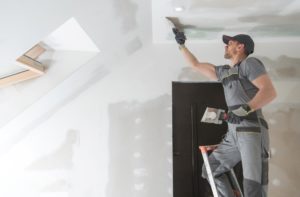
Professional advice for smoother walls and fewer wasted time
Hanging drywall may be a relatively straightforward project, even for do-it-yourselfers. and since it’s an interim step within the overall process of finishing a wall, any mistakes that do occur can still be covered up. But the ultimate task of finishing drywall can easily frustrate even very skilled do-it-yourselfers. Finishing is that the previous stage, and this suggests that you simply haven’t any more opportunities to repair flaws. this is often it. you would like to urge it right.
Drywall finishing requires an honest deal of expertise , which is why the gypsum wallboard industry and drywall professionals have codified a group of professional standards that breaks the method of finishing drywall into five distinct levels. Serious do-it-yourselfers should note of finishing levels if they need their finish to seem as professional as possible.
Drywall Finishing Levels
Level 0: Level 0 implies that no finishing of any type has been done. At this level, drywall is just fastened to the walls or ceiling.
Level 1: This level means drywall joint tape has been embedded in joint compound, but nothing further has been done.
Level 2: This next level means you’ve got skimmed a skinny coat of joint compound over the tape and covered the drywall screw holes. you’ll stop at this level if you plan to hide the wall surface with tile, or if it’s during a garage intended to be used for storage or a workshop-type space.
Level 3: At this stage, finishers apply a coat of joint compound to the tape and screws. Walls which will receive an important texture, like knockdown texture, can end at this level. it might be pointless to progress beyond this level since texturing will produce a finish that’s rougher than level 3.
Level 4: this is often the classic drywall finish. Here, you apply another coat of joint compound to the tape and screws and sand the dried compound. this is often the extent that typically is employed when a wall surface are going to be painted or covered with wallpaper.
Level 5: This highest possible level of drywall finishing involves applying a skim coat, if applicable.
There are 3 ways to use a skim coat:
Use a roller: Thinned joint compound is rolled onto the wall with a thick-nap roller. Excess is scraped off immediately.
Use a taping knife: A series of six or eight dabs of mud are applied, each about 3 to 4 inches in diameter. Immediately, the mud is smoothed across the surface, then excess mud is scraped off.
Spray finish: Professionals have spray equipment to permit them to spray on drywall compound. this sort of kit are often rented at rental yards or maybe at some home improvement stores.
Where Drywall Finishing Levels Apply
In a perfect world, all drywall—every sq in of it—would be mudded and sanded right down to a mirror-smooth surface. While this is often possible, it isn’t cost-effective. If you’re hiring out the work, every step requires a further visit from the drywall worker. For do-it-yourselfers, it’s yet one more day or two you increase the whole project. the character of the space and the way you employ it’s going to dictate the extent of drywall finish that’s appropriate:
Garages and workshops: A level 1 or 2 drywall finish could also be completely sufficient in garages and workshops. Why mud and sand an area that’s rarely ever seen? On the opposite hand, a car aficionado or a fanatical tinkerer might enjoy having a workspace that’s as clean and smooth as the other wall found within the residential a part of the house .
Wainscot-hidden wall surfaces: Are you fixing wainscoting? Then you do not need to put a premium finish on the lower 45 inches of your walls since it’ll get covered up anyway. A level 1 finish is ok for these areas.
Cabinet-hidden walls: Because kitchens are often blanketed with cabinets and appliances, much of the wall space doesn’t need A level 5 finish.
Ceilings: Conversely, ceilings tend to urge raked by natural light through the windows, highlighting pops, bumps, and depressions. for several homeowners, nothing but A level 5 will do on their ceilings. At the very least, ceilings always involve a level-4 finish.
When may be a Level-5 Drywall Finish Needed?
A level-5 finish may be a skim coat of joint compound (also referred to as mud) applied to a finish that you simply would normally leave at level 4.
There are two instances once you need A level 5 coating: when the finish are going to be glossy; or when light is be angled low enough to spotlight bumps and depressions. A level-5 finish is like icing on the cake. it is a premium finish that you simply won’t get by default; you absolutely will got to discuss this together with your contractor or drywall installer, because it isn’t normally considered a part of the finishing process.
Drywall finishing levels, in numeric terms, aren’t a traditional a part of the conversation between homeowners and contractors. Instead, you would possibly discuss the ultimate look or effect that you’re aiming for. you would possibly indicate that you simply want the dining room walls to be as smooth and flawless as possible or that the garage can have largely unfinished walls. It’ll be up to the contractor to translate your requests to the drywall technician.